
If you know you know (or you’ll know soon): UGK shaped a sound and feeling intrinsic to Houston.
Even after 30 years since their iconic namesake fifth album, Underground Kingz, the music of the legendary Texas duo, comprised of the late Chad “Pimp C” Butler and Bernard “Bun B” Freeman, still moves like H-town itself: expansive, bold, and full of basslines that sit heavy in your chest. Though UGK is often mentioned alongside Houston’s broader rap canon builders like Geto Boys and DJ Screw, the group actually came out of Port Arthur, a small Gulf Coast city just 90 miles east of Houston’s orbit.
That in-between space matters: it’s part of why their sound always felt like it was listening to the city from a slight distance — close enough to understand it, yet just far enough to stretch it into something new.
It took time for the rest of hip-hop to catch on to what Houston was doing. But once it did, it stayed.

By the early 2000s, UGK's collaborations with artists like Three 6 Mafia and JAŸ-Z helped widen the lens on Southern rap, pulling Houston into the national conversation without diluting its texture. Then, in 2005, Bun B’s solo debut, Trill, continued that legacy by giving it a name, a thesis, and a blueprint.
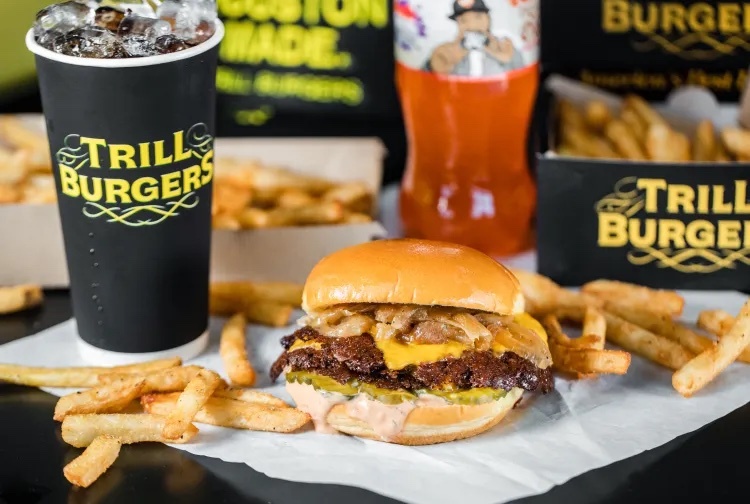
Since then, Bun B has expanded his presence far beyond music. In Houston, he’s also now part of the strong food narrative. In 2021, he co-founded Trill Burgers, a smashburger concept that quickly became one of the city’s most talked-about culinary projects. By 2022, it was named “Best Burger in America” by Good Morning America. In 2023, the restaurant opened its first brick-and-mortar location in Houston’s buzzy Montrose neighborhood, grounding itself in the city’s everyday rhythm.
Trill Burgers
3607 S Shepherd Dr
Houston TX, 77098
Burgers

Ahead of Bun B’s 30th anniversary UGK event in August, EatOkra spoke with the H-town legend about the early days of Trill Burgers, translating cultural legacy into food, and the future of Houston’s ever-evolving culinary landscape.
What’s been the most exciting aspect of being part of Houston’s food and beverage scene?
Being able to find connections with different bases. Initially, we were just a basic food company trying to get people to try the burger. We figured out how to leverage my celebrity and cultural influence to get people in front of the burger. Once we figured that out, we started using that to leverage relationships with artists who had high notoriety, influence, and interaction with their fan bases. Then, we started to look outside of low-hanging fruit, which was the cultural connection. The goal of Trill Burgers was always to be seen as different from any other burger received before. We knew we would hit the wall culturally at some point, and these influences would only go so far before the burger would have to start speaking for itself. We believe the burger does that very well.
A lot of the people who liked the burger were athletes — some of them retired. And a big pastime for retired athletes and retired men in general is golf. We started getting approached to cater golf tournaments; our first was with the Cactus Jack Foundation and Reggie Jackson’s golf tournament in Florida. From there, we branched out to DJ Khaled's golf tournament. Our frame of reference in the golf world has only expanded because we've continued to do Jim Crane's golf tournament in Florida. I’ve become part of a charity golf tournament that we throw in Houston called Taste of Trill. We did our first year together with Taste Kitchen. We brought in other vendors who are Black-owned or Black-led. We handed out awards. There were a lot of different food and drink stations as well as health and wellness stations, which we felt were important to expose people to those opportunities. We'll definitely be doing more in the future.

What do you feel is the connection between your cultural impact as an artist in music and heading this food empire?
I noticed in the midst of starting this company that I'm in the service business, and I've always been in the service business. So, when I started to look at the burger in the same way that I would look at music — like the way I would put deep thought into how music was presented and the order of songs on an album and making sure that whenever we performed music it was as close to the product people bought as possible — then, I started looking at the burger like I'm going city-to-city like an artist on a promo tour.
It used to cost us to be in certain buildings because we didn't have the level of notoriety to demand prices from promoters. So, we would have to pay full price just like every other vendor trying to get into Coachella, Rolling Loud, Something in the Water, and events like that. We went through those new business hurdles, but we had connectivity to different people at these festivals. So, yeah, we had to pay the price to get into Coachella, but now we're vending at Coachella. I was going to get to know someone’s manager, DJ, and some of the different artists. I was able to give them that burger. Hopefully, they liked it, and they posted it on their socials — and for the most part, that’s pretty much what happened. Again, we still had to pay the cost to get into the building, and it was worth that cost because of the residual marketing benefits from getting celebrity endorsements without having to pay people.
You've always been ahead of the curve musically and creatively. You’re a businessman with a strategy. So, what made you choose a burger as your entry into the food space?
The burger chose me. It was presented to me. So, this is not my burger, and it's not my recipe. It's Chef Mike [Pham] and Chef Fernando [Valladares].

So, two friends of mine, Andy Nguyen and Nick Scurfield, reached out to me about partnering with them for a burger concept they were looking to do in Houston that already had a lot of momentum on the West Coast, even through to Oklahoma. So, they would miss the momentum if they didn't jump on the smashburger wave by the time it got to Texas. They knew they had the idea, and they just wanted a partner that could help get eyes on the brand and get them some added attention — and I was able to do both.
What made you believe in this burger? What was the “a-ha” moment when you knew you wanted to be part of the project?
The first tasting was good, but the final tasting was the one that sealed the deal. When we did the final tasting, the chefs from California had to come in and teach people how to cook the burger properly. The operators did it well the first time, but they said it could be better. So, they re-taught them how to make the burger. Then, they represented it, and it was like, ‘Yeah, this is a badass burger. Let’s go.’ It was just a matter of doing the first pop-up and hoping everybody else felt the same way I did about the burger. From day one, we knew we really had something.
Growing up in Houston and living there part-time now, I’ve noticed how much the food scene has evolved. Certain chains, such as Timmy Chan’s and Frenchy’s, were staples unique to Houston. So, with Trill Burgers, do you want that identity to shine through as being only a Houston mainstay, or are you keen for a global takeover?
Everybody in Houston should try Trill Burger. It's been here long enough. But I want to make sure that every person in the world has a chance to try this burger. I don't look at this as a mom-and-pop brand anymore because I'm not looked at as a mom-and-pop brand. We started very small, but it turned out that what we were doing was being received by more people than we were giving ourselves credit for. So, just as we had to find more ways to make the music we were doing available to more people, that's the same way we feel about this burger. We absolutely wanted Houston to love this burger, and Houston built this brand. Even Houston knows that this is the best burger in the world, and they want to prove to everybody that the best burger in the world indeed comes from Houston. So, the best way to do that is to have this burger present in as many places as possible. Potentially, that's the kind of company we believe we can become.
Piggybacking off this idea of expansion, you were talking about bringing chicken to the city through Trill Tenders back in 2024. Is that something that you're still pursuing?
We introduced Trill Tenders to the city during our Rodeo activations earlier this year. We're now prepared to present Trill Tenders with a brick-and-mortar. We put an LOI in for a specific location, and we’re waiting to see how that goes. We believe Trill Tenders has enough energy and motion to stand on its own. We don't want to complicate Trill Burger kitchens that are running very well on their own. So, we're going to make Trill Tenders its own entity and develop its own team around it. We would love to see a Trill Tenders location by Christmas.
Congrats in advance! I know that's going to be a success. What do you foresee trending within Houston’s overall food culture?
A lot more fusion. Over a hundred different languages are spoken in Houston, and all these cultures have their own respective culinary scene and different foods directly connected to the culture. The more we see people representing their culture, the more opportunities we see for a more localized version. So, we have a large Vietnamese community in Houston and the surrounding areas, and a big community of people who like to eat crawfish. Vietnamese people eat crawfish, but they season it differently. Typically, people in America season crawfish with powdered seasonings, whereas the Vietnamese tend to use more oil for seasoning. So, now you have these Viet-Cajun places all over town incorporating powder seasoning and oil.
Earlier this year, we collaborated with Crawfish & Noodles. We were able to execute that because we have multi-national ownership. There’s Black, Latino, and Asian ownership. So, we get to take advantage of having that type of ownership to do cross-cultural collaborations without it being appropriation. We’ve collaborated with other Asian restaurants and a Nigerian one (ChòpnBlọk), too. These different collaborations allow us to expand our outlook and reach in the city, and also create very unique, authentic experiences for Houston diners.

Reflecting on Beyoncé's Cowboy Carter, you once said she was "sending the right message to the world" about cultural belonging and that your own contribution to the Houston Livestock Show and Rodeo was about "bringing attention to whether or not we should feel welcome." Whether it's country music, fine dining, or rodeo culture, how do you see Black artists and entrepreneurs continuing to make those spaces undeniably ours?
It's not just about us feeling welcome and understanding that we're welcome, but the people that we normally serve and the people that we, daily, are connected with are aware that they're just as welcome, and you can see that nowadays with the Houston Livestock Show and Rodeo. For five years, we've seen the way that Black people look at and approach the Rodeo, and now connect with and represent at the Rodeo. Without having to compromise any of their Blackness or their culture, they now come in and understand exactly what the assignment is. People feel more comfortable, not just about coming to the Rodeo, but being representative of Black culture at the Rodeo. Maybe earlier, we didn't see that level of representation in those buildings and spaces, but it's absolutely unmistakable of who we are, how we impact, and how we represent Houston. We have our own level of representation, and we feel empowered by that now. We're ready to show up and show out.
This interview has been edited for length and clarity.
Featured image by Quit Nguyen