
He started experimenting with dishes at three years old — "but I don't know if they were nice," he says. By eight, Chef Paul Carmichael was cooking full meals for his family in Barbados.
Today, he's behind two of New York's most talked-about restaurants. Kabawa is a prix-fixe East Village dining room that the New York Times named the #1 restaurant in New York City and Food & Wine called the best restaurant in America. Bar Kabawa is the daiquiri-and-patty bar next door.
Carmichael caught up with EatOkra at Bar Kabawa to talk about cooking from the source, the love letter he's writing to an entire region, and what it means to honor a cuisine and push it forward at the same time.
On Kabawa and Bar Kabawa as a love letter to the Caribbean
"I wanted a space for our people that could represent the whole region. Not just be spotlighted in one specific place. There are a lot of islands that have done an amazing job at marketing, but they're not the only ones that exist. So I guess that's my little space to showcase other places."
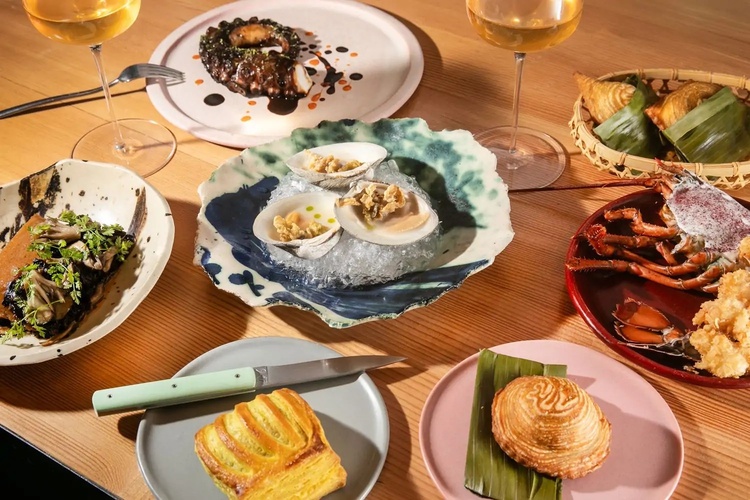
Bar Kabawa
2 Extra Pl
New York NY, 10003

On the biggest misconception about Caribbean food
"That it's all jerk chicken and rice and peas. Although rice and peas — or peas and rice — goes through the entire region, irregardless of the colonial group. It's the same.
There's Africa in everything. All those connections make it super interesting. The more you delve into it, the more you see similarities, but also a lot of differences. Like a Puerto Rican could really enjoy Jamaican food and vice versa — they're very different, but the connections are the same. And that's what I like about it."
On honoring tradition while pushing it forward
"It's understanding the source material through and through before you start changing it. If you know the source material, it's like building a car — there's a big difference between a Kia Sportage and an F1 vehicle. But there's an engine and four wheels. If you understand the things you need to make a car a car, then you can push forward.

I wanna start from a place of reality and then expand. If we understand the core, then we can play. I don't wanna say, 'Here's this Cou-cou dish,' and then someone eats it and it tastes nothing like Cou-cou. I've lost.
It's also kind of disrespectful to all the people that worked on said dishes for hundreds of years. If something's gonna be something, it needs to be that thing, irregardless of what it looks like when it's done. The feeling you get when you eat it, that nostalgia, especially if you've had it as a kid needs to be there. Otherwise, you're just doing what everybody else is doing."
On why he doesn't have a favorite dish
EatOkra dined at Bar Kabawa, where Carmichael's menu centers on daiquiris and eight rotating patty fillings — four fried, four baked. His recommendations for first-timers:
"Have a daiquiri. And then explore the menu as you see fit. You're from EatOkra, so get the okra. And get the Solomon Gundy. Then choose whatever patties you feel, but definitely get a daiquiri for sure.
My favorite isn't going to be your favorite because we're different people. My favorite might not be because of taste, but because of how much trouble it took me to get on a plate. I revel in that failure — this took a lot of tries until it was there, and I hold it dear to my heart because it was a lot."
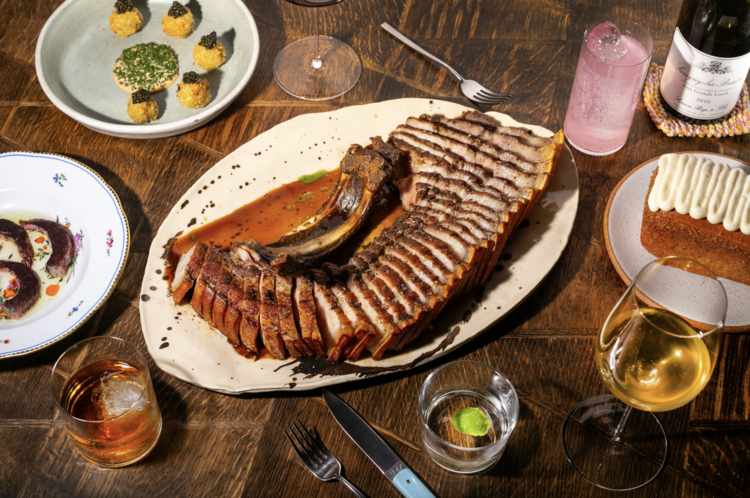
Kabawa
8 Extra Pl
New York NY, 10003
On the oral history of Caribbean food — and what's at risk of being lost
"In the Caribbean, there's no real written history about food. A lot of things are oral and taught. When that generation of people — the boomers and above — die, a lot of things will be lost. They have so many reps and they just teach in a specific way and nothing's written down.
My generation and below, people are cooking less and less in the Caribbean. Their expectation of things is very, very different.
And that's why I say: love the stuff that you have, because it's amazing. Food from other countries is also amazing, but it doesn't have to trump ours. Especially when you're home with it."
You've got to "C" it to believe it. Our ongoing Culinary Creatives Chat series is a virtual space to empower Black food entrepreneurs through testimonies from thriving industry peers.